MultiTox-Glo Multiplex Cytotoxicity Assay
Measures Relative Number of Live and Dead Cells
- Fluorescent and luminescent assay
- Normalize data with a built-in internal control
- Immediately identify more false-positives and false-negatives

Catalog Number:
Size
Catalog Number: G9270
Catalog Number: G9271
Catalog Number: G9272
A Bioluminescent and Fluorescent Detection Assay
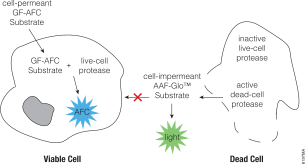
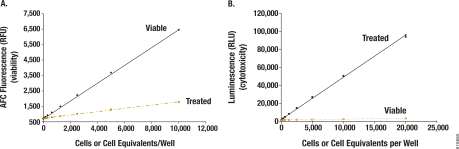
The MultiTox-Glo Multiplex Cytotoxicity Assay is a sequential-reagent-addition fluorescent and luminescent assay that measures the relative number of live and dead cells in cell populations. The assay sequentially measures two protease activities; one is a marker of viability, and the other is a marker of cytotoxicity. The live-cell protease activity is restricted to intact viable cells and is measured using a fluorogenic, cell-permeant, peptide substrate (GF-AFC). This substrate enters intact cells, where it is cleaved by the live cell protease activity to release AFC and generate a fluorescent signal that is proportional to the number of viable cells. The live-cell protease becomes inactive upon loss of membrane integrity and leakage into the surrounding culture medium.
A second, luminogenic cell-impermeant peptide substrate (AAF-aminoluciferin) is used to measure dead-cell protease activity, which is released from cells that have lost membrane integrity. The liberated aminoluciferin product is measured as "glow type" luminescence generated by Ultra-Glo™ Recombinant Luciferase provided in the assay reagent.
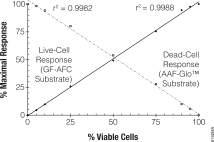
The MultiTox-Glo Assay gives ratiometric, inversely correlated measures of cell viability and cytotoxicity, which correlate with established methods for measuring viability and cytotoxicity. The ratio of viable cells to dead cells is independent of cell number and, therefore, can be used to normalize data. Having complementary cell viability and cytotoxicity measures reduces errors associated with pipetting and cell clumping, as well as serving as an internal control to allow identification of errors resulting from chemical interference from test compounds or media components. A luminescent readout allows for a reduction in the statistical probability of false-positives (or false-negatives) and eliminates fluorescence interference issues.
The Biology of the MultiTox-Glo Multiplex Cytotoxicity Assay
The MultiTox-Glo Assay Measures Distinct and Differential Protease Activities
Viability and Cytotoxicity Measurements Are Inversely Correlated and Ratiometric
Notes
Using 100μl/assay in a 96-well plate format, Cat.# G9270 is sufficient to perform 100 assays; Cat.# G9271, 500 assays; Cat.# G9272, 1,000 assays. Using 25μl per well in a 384-well plate format, Cat.# G9270 is sufficient to perform 400 assays; Cat.# G9271, 2,000 assays; Cat.# G9272, 4,000 assays.Protocols
Specifications
Catalog Number:
What's in the box?
| Item | Part # | Size |
|---|---|---|
|
Assay Buffer |
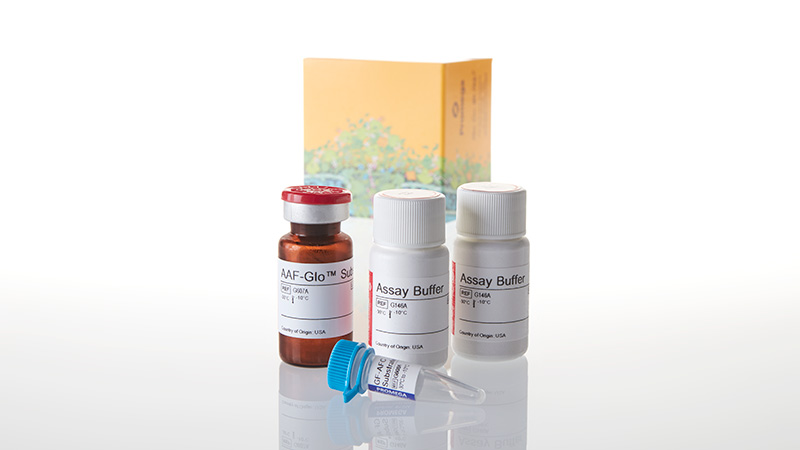
G146A | 2 × 5ml |
AAF-Glo™ Substrate |
G607A | 1 × 1 bottle |
|
GF-AFC Substrate |
G608A | 1 × 10μl |
SDS
Search for SDSCertificate of Analysis
Use Restrictions
For Research Use Only. Not for Use in Diagnostic Procedures.Storage Conditions
What's in the box?
| Item | Part # | Size |
|---|---|---|
|
Assay Buffer |
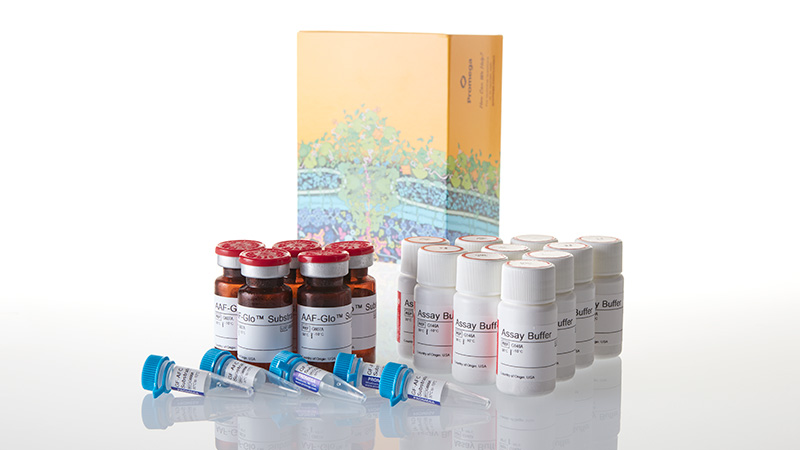
G146A | 10 × 5ml |
AAF-Glo™ Substrate |
G607A | 5 × 1 bottle |
|
GF-AFC Substrate |
G608A | 5 × 10μl |
SDS
Search for SDSCertificate of Analysis
Use Restrictions
For Research Use Only. Not for Use in Diagnostic Procedures.Storage Conditions
What's in the box?
| Item | Part # | Size |
|---|---|---|
|
Assay Buffer |
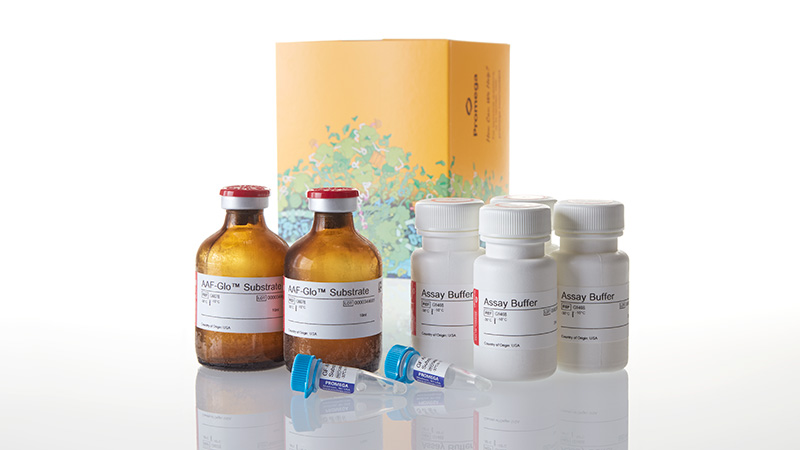
G146B | 4 × 25ml |
|
AAF-Glo™ Substrate |
G607B | 2 × 1 bottle |
|
GF-AFC Substrate |
G608B | 2 × 50μl |
SDS
Search for SDSCertificate of Analysis
Use Restrictions
For Research Use Only. Not for Use in Diagnostic Procedures.Storage Conditions
Resources
No related resources available
Related Products
Similar Products
MultiTox-Fluor Multiplex Cytotoxicity Assay
A single-reagent-addition fluorescent assay that measures the number of live and dead cells in culture wells.
G9200, G9201, G9202
RealTime-Glo™ MT Cell Viability Assay
A bioluminescent method to kinetically monitor viability in cell culture up to 72 hours.
G9711, G9712, G9713
CellTiter-Glo® Luminescent Cell Viability Assay
Determine the number of viable cells in culture based on quantitation of ATP present.
G7570, G7571, G7572, G7573
ApoLive-Glo™ Multiplex Assay
Measure viability and caspase-3/7 activity in the same sample well to confirm mechanisms of cell death.
G6410, G6411
Frequently Used With
CellTiter-Glo® Luminescent Cell Viability Assay
Determine the number of viable cells in culture based on quantitation of ATP present.
G7570, G7571, G7572, G7573
CytoTox-Fluor™ Cytotoxicity Assay
A single-reagent-addition, homogeneous, fluorescent assay that measures the relative number of dead cells in cell populations.
G9260, G9261, G9262
CytoTox-ONE™ Homogeneous Membrane Integrity Assay
A homogeneous, LDH-based fluorometric method for quantifying non-viable cells.
G7890, G7891, G7892
GloMax® Discover System
High-performance microplate reader for detecting luminescence, fluorescence and absorbance.
GM3000